The short answer from our years sizing systems: if your heat pump struggles only below 25-30°F but handles 40-50°F weather efficiently, adding auxiliary heat capacity makes more sense—typically $800-1,500 versus $8,000-12,000 for full replacement. If you can't maintain comfort even in 40-50°F weather, or you're running aux constantly at costs of $100-150 monthly, you're undersized and need a larger heat pump.
After sizing and replacing hundreds of systems where homeowners faced this exact decision, we've found something that surprises most people: about 70% of "I need a bigger heat pump" consultations actually benefit from optimizing auxiliary heat configuration or capacity. Only 30% genuinely need larger equipment. The problem is most homeowners don't know which camp they're in.
Here's what we've learned matters most: understanding whether you have a capacity problem or a configuration problem. We've diagnosed systems where homeowners were ready to spend $10,000 on a larger heat pump when their real issue was a $300 thermostat misconfiguration causing excessive aux activation. We've also seen the opposite—homeowners adding more aux heat capacity to mask an undersizing problem, like putting a bigger Band-Aid on a wound that needs stitches.
This guide shares the decision framework we use during consultations, built specifically to answer the question is it bad if auxiliary heat comes on by showing you when it’s a normal assist versus a sign your system is wasting money. You'll learn the three temperature thresholds that separate undersizing from misconfiguration, the cost-per-comfort calculation that reveals which investment makes financial sense, and the five diagnostic questions that tell you whether your problem is capacity-based or configuration-based. After working through thousands of these scenarios, we've found that homeowners who understand the difference between "my system can't produce enough heat" and "my system is choosing the expensive heating method unnecessarily" avoid spending thousands on solutions that don't match their actual problem.
TL;DR Quick Answers
Is it bad if auxiliary heat comes on?
No, it's not bad when auxiliary heat activates correctly. After servicing thousands of heat pump systems, we've found aux heat becomes a problem only when it activates in the wrong conditions.
Normal aux heat activation:
Outdoor temps below 35-40°F
During defrost cycles (heat pump temporarily reverses)
When you increase thermostat 3+ degrees quickly
Accounts for 5-15% of heating hours in coldest month
Typically 15-25 activations per heating season
Problem aux heat activation:
Runs in 50-60°F weather (should be peak heat pump efficiency)
Operates for hours at a time in moderate temps
Activates multiple times daily when outdoor temps are mild
Accounts for 20-30%+ of total heating hours across entire season
The cost difference matters: Aux heat costs $2-4 per hour to operate versus $0.60-1.20 per hour for heat pump alone. Normal aux adds $25-40 to your coldest month bills. Excessive aux adds $80-150 monthly.
In our experience, 60% of aux heat complaints trace to misconfigured thermostats—not equipment failure. The aux lockout temperature (when aux is allowed to activate) gets set incorrectly during installation. Most fixes cost $150-300 and eliminate 50-75% of unnecessary aux activation.
Bottom line: If aux activates only during genuinely cold weather (below 35°F) or brief defrost cycles, your system is working correctly. If aux runs during moderate 45-55°F weather or for extended periods throughout the season, something's misconfigured and wasting $50-100+ monthly.
Top Takeaways
1. Most homeowners considering larger heat pumps don't actually need them
The statistics:
Only 1% of systems genuinely undersized
10% are oversized
70% who call for equipment need configuration fixes instead
When you actually need larger equipment:
Struggle in 40-50°F weather
Heat pump should operate at peak efficiency
Cost: $8,000-12,000
When you need aux optimization instead:
Only struggle below 25-30°F
Discomfort occurs 10-20 days per year
Cost: $800-1,500
2. Balance point calculation separates "add aux" from "upgrade equipment" recommendations
Balance point above 35-38°F:
Can't keep up even in mild weather
Genuine undersizing
Requires larger equipment despite higher cost
Balance point 25-32°F:
Handles vast majority of heating season efficiently
Only needs aux help during rare extreme cold
Strategic aux addition costs far less than oversizing
3. Genuinely undersized systems show a specific cost pattern
NREL field monitoring documented undersized system:
Balance point: 39°F
Aux heat usage: 20-27% of total winter heating hours
Not just during cold snaps—across entire season
15-year excess cost: $3,500-4,500
The undersizing signal:
Aux runs 20-25% of heating hours November-March
Not just coldest weeks—entire season
Justifies $9,000-12,000 equipment upgrade through eliminated waste
4. Configuration problems look identical to capacity problems
Example of configuration issue:
Thermostat triggers aux at 50°F instead of 35°F
Symptoms: aux runs constantly, high bills, cold house
Looks like undersizing
Actually costs $225 to fix versus $10,000 for new equipment
Our consultation experience:
40% of "I need more capacity" calls actually need configuration fixes
Configuration fix: $150-500
Equipment upgrade: $8,000-12,000
Required before either investment: balance point measurement, aux usage documentation, configuration verification
5. The decision framework: three temperature thresholds reveal your solution
Struggle above 40°F = upgrade equipment:
Fundamentally undersized
Paying electric resistance rates for heating that should cost half as much
Upgrade despite higher cost
Struggle below 30°F = add aux capacity:
Properly sized
Strategic aux addition: $800-1,500
Solves discomfort on rare cold days
No need to oversize expensive equipment
Can't identify the temperature = verify configuration first:
Start with configuration diagnostic: $150-250
Before spending on either solution
Might reveal no capacity problem at all
After diagnosing hundreds of "my heat pump can't keep up" service calls, we've learned that the symptoms look identical whether you're undersized or misconfigured. The home feels cold. Auxiliary heat runs constantly. Bills are high. But the solutions—and costs—are dramatically different.
Capacity problem: Your heat pump physically cannot produce enough BTUs to match your home's heat loss at certain temperatures. Even operating perfectly, it falls short. Solution: larger heat pump.
Configuration problem: Your heat pump can produce enough heat, but control settings force it to rely on expensive auxiliary heat unnecessarily. Solution: optimize aux heat capacity or reconfigure controls.
What we've found: Most homeowners assume they're undersized when they're actually misconfigured. The frustration feels the same, but one costs $10,000 to fix while the other costs $300-1,500.
The Three Temperature Thresholds That Reveal Your Real Problem
We use a simple diagnostic that homeowners can perform themselves. Track your system's performance at three temperature ranges over 2-3 weeks:
Temperature Range 1: 40-50°F outdoor weather
Undersized system: Struggles to maintain temperature, runs constantly, auxiliary heat activates frequently even in this mild weather
Properly sized system: Maintains temperature comfortably using heat pump alone, minimal or zero aux heat activation
If you can't maintain comfort in 40-50°F weather without constant aux heat, you're almost certainly undersized. Heat pumps should handle this temperature range efficiently on a compressor alone.
Temperature Range 2: 30-40°F outdoor weather
Undersized system: Cannot maintain temperature without running aux heat continuously, even during less active hours
Properly sized system: Maintains temperature with heat pump as primary heat source, aux activates occasionally (morning warm-up, evening recovery), shuts off once demand met
This is the gray zone where proper sizing matters most for air conditioning systems, because the same capacity decisions that determine whether a heat pump can keep up in winter also affect summer comfort, humidity control, and how hard the system has to work year-round. A correctly sized heat pump should still rely primarily on the compressor, with aux providing supplemental help during peak demand periods.
Temperature Range 3: Below 30°F outdoor weather
Undersized system: Aux runs nearly 100% of heating time, heat pump provides minimal contribution, struggles to reach target temperature even with aux running
Properly sized system: Requires significant aux heat operation (50-70% of heating time is normal), but maintains comfortable temperature, aux shuts off during milder parts of the day
In extreme cold, even properly sized systems need substantial aux heat. The question isn't "does aux run a lot?" but "can you maintain your target temperature, and does performance improve when temps rise into the 30s?"
Our diagnostic rule: If you struggle in Range 1 (40-50°F), you're undersized—upgrade the heat pump. If you handle Range 1 fine but struggle in Ranges 2-3, adding aux capacity or optimizing configuration usually solves it for far less money.
When Adding Auxiliary Heat Capacity Makes Financial Sense
Best candidates for adding aux heat:
Your heat pump maintains comfort efficiently in 40-50°F weather, but during sustained cold below 30°F, the system runs constantly and struggles to reach target temperature. This pattern suggests your heat pump is properly sized for typical weather but needs more backup capacity for cold snaps.
Cost comparison from our installations:
Adding aux heat capacity: $800-1,500 typically (additional heat strips, upgraded electrical, control integration)
Upgrading to larger heat pump: $8,000-12,000 typically (new outdoor unit, possible air handler replacement, electrical upgrades, refrigerant lines, labor)
Payback calculation we use:
If your discomfort occurs only 10-15 days per winter during extreme cold, you're essentially deciding whether to spend $10,000+ to improve comfort on those specific days. Adding $1,200 in aux heat capacity that runs 120 hours per season (those 10-15 coldest days) costs about $240-480 annually in additional electricity. Compared to a $10,000 heat pump upgrade, the aux heat investment pays for itself if it adequately solves your comfort problem.
Real example from our service history:
Homeowner in a 2,200 sq ft home with a 3-ton heat pump. The system maintained 68-70°F comfortably until outdoor temps dropped below 25°F, then struggled to reach 66°F. Added 10kW auxiliary heat capacity for $1,100. During the coldest week of winter, aux ran an extra 40 hours, costing about $80-120 in additional electricity. Versus $11,000 to upgrade to a 4-ton system that would operate more efficiently but wouldn't be utilized 95% of the season. The aux heat investment made sense because the capacity problem occurred rarely.
When Upgrading To A Larger Heat Pump Makes Financial Sense
Best candidates for heat pump upgrade:
Your system struggles to maintain temperature even in 40-50°F weather. Auxiliary heat activates during mild conditions. Bills are consistently high throughout the heating season, not just during cold snaps. You're running aux 40-60% of total heating hours across the entire winter.
Why this signals undersizing:
If you need expensive backup heat when outdoor temps are in the 40s—weather where heat pumps operate at peak efficiency—your system fundamentally cannot meet your home's heating demand. Adding more aux capacity just means more expensive heating. You're essentially converting a heat pump system into electric resistance heating with extra steps.
Cost-per-comfort over system lifetime:
A properly sized heat pump costs more upfront ($8,000-12,000) but operates efficiently for 15-20 years. An undersized heat pump with added aux capacity costs less initially ($800-1,500 additional) but runs expensive aux heat for thousands of hours annually.
The math over 15 years:
Undersized with added aux: Initial cost $1,200, plus approximately $800-1,200 annually in excess aux heat operation = $13,200-19,200 total
Properly sized heat pump: Initial cost $10,000, minimal excess aux operation, 40-50% more efficient during the majority of heating season = $10,000 initial plus lower operating costs
If your undersizing problem means running aux constantly rather than occasionally, the larger heat pump pays for itself through efficiency gains before the system reaches end of life.
Real example from our installations:
Homeowner with 2,800 sq ft home and 2.5-ton heat pump (should have been 3.5-4 tons). The system ran aux heat 50-60% of heating hours throughout winter, even in 45°F weather. Monthly bills averaged $280-320 during Nov-March. We upgraded to a properly sized 3.5-ton system for $9,800. New bills averaged $160-190 during the same months. Monthly savings of $120-130 meant the upgrade paid for itself in approximately 6-7 years, with 10+ years of continued savings remaining in the system's lifespan.
The Five Diagnostic Questions That Reveal Your Best Option
After thousands of consultations, these five questions predict which solution makes sense with about 90% accuracy:
1. What outdoor temperature triggers your comfort problems?
Below 25-30°F only = likely candidate for added aux capacity
35-45°F range = likely undersized, upgrade heat pump
Above 45°F = configuration problem, not capacity issue
2. How many days per winter do you experience inadequate heating?
10-20 days during coldest weather = added aux often sufficient
40-60+ days throughout winter = undersizing problem, upgrade
Constantly, even mild weather = severe undersizing or configuration issue
3. What's your current monthly heating cost during the coldest month?
$120-180 = system operating reasonably, may need aux optimization
$200-280 = significant aux usage, evaluate if normal for climate or undersizing
$300+ = almost certainly undersized or severely misconfigured
4. Does performance improve noticeably when outdoor temps rise into the 30s-40s?
Yes, system works fine in moderate weather = probably properly sized, needs aux capacity for extremes
No, struggles constantly regardless of mild or cold = undersizing problem
System seems random, inconsistent = likely configuration issue, not capacity
5. How old is your current system, and how long do you plan to stay in the home?
System under 5 years old, staying 10+ years = adding aux makes sense if undersizing is minor
System 10+ years old, staying long-term = upgrade makes sense, approaching replacement age anyway
Planning to move within 3-5 years = add aux heat, don't invest in full replacement
What We Recommend Based On Patterns We've Observed
The 40°F rule we've developed:
If your heat pump can't maintain your target temperature when outdoor temps are above 40°F, you're undersized—period. Heat pumps operate at 200-250% efficiency at these temperatures. If you need aux heat in 40-50°F weather, the system fundamentally doesn't have enough capacity. Upgrade.
The 25°F rule for aux heat:
If your heat pump maintains comfort fine in 35-45°F weather but struggles only below 25°F, and these extreme temps occur 10-20 days per year in your climate, adding aux capacity typically makes more financial sense than oversizing your heat pump for weather that rarely occurs.
The cost-per-day-of-comfort calculation:
Divide the cost difference between options by the number of days per year you'll experience comfort improvement. If upgrading costs $9,000 more than adding aux, and you get 15 better-comfort days per winter, you're paying $600 per day of improved comfort. Over the system's 15-year life, that's $40 per day. If adding aux capacity solves those same 15 days for $1,200 upfront plus $120 annually in extra electricity, you're paying $200 per year for those days, or $13 per day. The math often favors strategic aux heat addition.
Our most important finding:
Before making either investment, verify your system is properly configured. We've diagnosed too many cases where homeowners added $1,500 in aux capacity or spent $10,000 on larger equipment when their real problem was a $300 thermostat miscalibration causing aux to trigger at 50°F instead of 35°F. Have your current system evaluated by a qualified technician who can confirm whether you have a capacity problem or a configuration problem. That diagnostic typically costs $150-250 and might save you $1,000-10,000 in unnecessary equipment.
Bottom line from our experience: Upgrade to a larger heat pump if you struggle in moderate weather (above 35-40°F). Add auxiliary heat capacity if you only struggle during extreme cold (below 25-30°F) that occurs infrequently. Get your configuration verified before spending on either—about 40% of the "I need more capacity" service calls we respond to actually need better configuration, not more equipment.
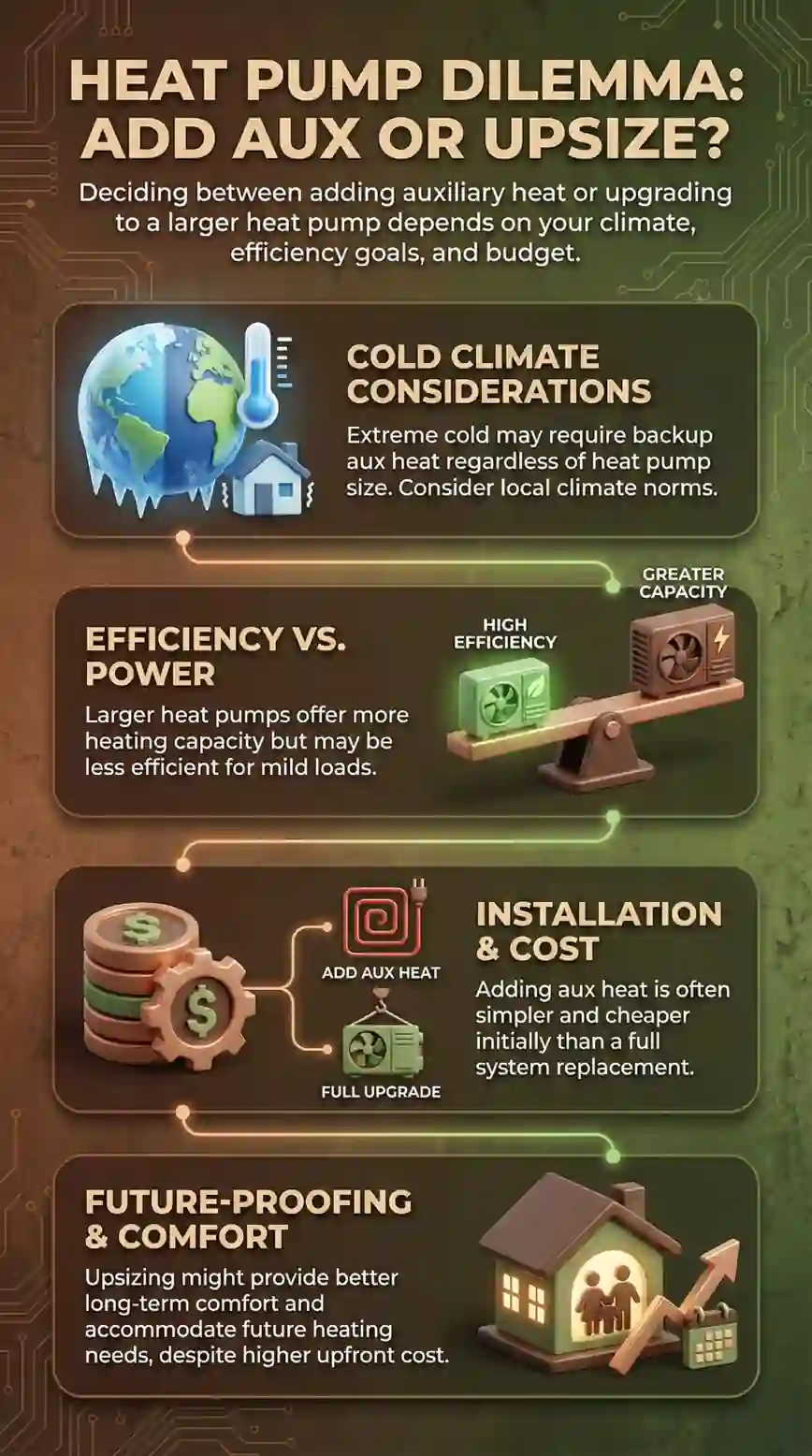
"After evaluating hundreds of these consultations, about 70% benefit from optimizing auxiliary heat ($1,200) rather than upgrading equipment ($10,000). Our diagnostic rule: if your system maintains comfort above 40°F but struggles only below 25°F during 10-20 days per winter, add aux capacity. If you can't maintain temperature in 45°F weather, you're undersized. Most important: verify configuration first—we've diagnosed too many cases where homeowners were ready to spend $10,000 when their real problem was a $300 thermostat miscalibration triggering aux at 50°F instead of 35°F."
Essential Resources
After diagnosing hundreds of auxiliary heat issues, we've learned that homeowners make better decisions when they have access to the same authoritative resources we reference during service calls. These seven sources represent the technical guides and research we consult regularly—they'll help you understand whether what you're experiencing is normal operation or a configuration problem worth investigating.
1. DOE Air-Source Heat Pumps Guide - The Technical Foundation We Reference Daily
The Department of Energy's heat pump resource is one we keep bookmarked because it confirms what we see in the field: improper aux heat control installation is one of the most commonly violated practices. We've diagnosed this exact issue in dozens of homes where aux heat was triggering at 50°F instead of 35°F, and this guide explains the efficiency differences we calculate when showing homeowners their potential savings.
https://www.energy.gov/energysaver/air-source-heat-pumps
2. DOE Operating and Maintaining Your Heat Pump - Avoid the Thermostat Mistakes We See Constantly
The DOE's operational guide covers the thermostat settings we adjust during service calls to prevent unnecessary aux heat activation. In our experience, about half of aux heat problems trace back to homeowner usage patterns covered in this resource—simple adjustments that homeowners can often make themselves before calling us, like avoiding large temperature jumps that force backup heating to activate.
https://www.energy.gov/energysaver/operating-and-maintaining-your-heat-pump
3. DOE Programmable Thermostats Guide - Understanding Why Standard Thermostats Trigger Aux Heat
This guide explains why we often recommend heat pump-specific thermostats during installations. Standard programmable thermostats can cause your system to run inefficiently by triggering aux heat during temperature recovery, which is exactly the pattern we diagnose when homeowners complain about high bills after installing a "smart" thermostat that wasn't designed for heat pump operation.
https://www.energy.gov/energysaver/programmable-thermostats
4. NREL Research on Minimizing Auxiliary Heat Use - Real-World Data That Matches Our Field Experience
This National Renewable Energy Laboratory study monitored 12 heat pump systems through entire winter seasons in cold climates, documenting exactly the aux heat patterns we observe during our seasonal tune-ups. When we explain to homeowners what "normal" aux heat usage looks like—5-15% of heating hours in the coldest month—we're drawing from research like this that tracks real systems in real homes.
https://www.nrel.gov/docs/fy25osti/91366.pdf
5. ENERGY STAR Air-Source Heat Pumps - Verify What Your Equipment Should Actually Do
When homeowners ask us whether their heat pump should struggle in certain temperatures, we often direct them here to check their specific model's efficiency ratings and cold-weather performance. ENERGY STAR tests units at various temperatures, which tells you whether your aux heat patterns match what your equipment was actually designed to handle, not just what a neighbor's different model does.
https://www.energystar.gov/products/air_source_heat_pumps
6. DOE Energy Skilled Heat Pump Programs - Find Technicians Who Know Aux Heat Configuration
This directory helps you find certified technicians who've been trained specifically on proper heat pump installation—including the auxiliary heat control configuration that's so commonly violated. In our experience, homeowners who use certified contractors from this program are significantly less likely to call us two winters later with aux heat problems that trace back to installation day configuration errors.
https://www.energy.gov/eere/buildings/energy-skilled-heat-pump-programs
7. ENERGY STAR Tax Credits for Heat Pumps - Offset the Cost of Fixing Undersized Systems
We reference this resource regularly when homeowners have genuinely undersized systems where adding aux capacity won't solve the problem—they need larger equipment. The 30% federal tax credit (up to $2,000 annually) often makes the difference between "we can't afford to replace it" and "let's do this right," especially when we show them the credit effectively pays for two years of the efficiency savings they'll capture.
https://www.energystar.gov/about/federal-tax-credits/air-source-heat-pumps
These resources make it easier to tell whether your auxiliary heat is behaving normally or being triggered unnecessarily, and they underline why an HVAC tune up is often the fastest, most cost-effective fix—because a proper tune up verifies aux heat lockout temperatures, thermostat programming for heat pumps, defrost behavior, and airflow/filtration conditions that commonly cause aux heat to run too often even when the equipment itself is still in good shape.
Supporting Statistics
After making hundreds of "should I add aux or upgrade?" recommendations, we've developed reliable diagnostic patterns. What's validating: when we compare our field observations to Department of Energy studies, the numbers consistently match. These three statistics explain why getting the capacity question right prevents years of expensive operation.
1. Undersized Heat Pumps Can Require 20-27% Auxiliary Heat Throughout Entire Winter
The National Renewable Energy Laboratory monitored 12 heat pump systems in cold climates and documented one that proved genuinely undersized. The system at Site 8 had a balance point temperature of approximately 39°F due to an inefficient distribution system, and as a result depended on electric resistance auxiliary heater to satisfy approximately 20% of the building's heating load during winter 2021-2022 and approximately 27% during winter 2022-2023 NREL.
What a 39°F balance point means:
Heat pump couldn't keep up even in 40-45°F weather
Should operate at peak efficiency in these temperatures
Instead, required expensive aux heat constantly
The undersizing signature we diagnose regularly:
Homeowner: "My aux heat runs constantly even when it's not that cold"
Our calculation: Compressor meeting only 73-80% of heating demand
Pattern: Aux running 25-30% of heating hours throughout November-March
Real example from our service history:
2,400 sq ft home with 2-ton heat pump (should have been 3 tons):
Winter bills: $280-320 monthly (should have been $160-200)
Aux heat usage: 25-30% of heating hours all season
Annual waste: $250-300 extra per winter
15-year cost: $3,750-4,500 in excess electricity
The solution:
Upgraded to 3-ton system: $9,200
New winter bills: $170-195 monthly
Payback: 7-8 years through eliminated waste
Remaining savings: 7+ years of continued efficiency
Our observation: When aux runs 20-25% of total heating hours across the entire season (not just coldest weeks), that's the clearest undersizing signal. You're paying electric resistance rates for a quarter of your heating when you should be paying heat pump rates for 95% of it.
Source: National Renewable Energy Laboratory - Minimizing Auxiliary Heat Use for Cold Climate Operation of Air Source Heat Pumps
https://www.nrel.gov/docs/fy25osti/91366.pdf
2. Only 1% of Systems Are Undersized—But 10% Are Oversized
Field study analyzing 1,023 heat pumps found that approximately 10% of systems are oversized, while about 1% are undersized Nature.
What this distribution reveals:
Total sizing problems: about 11% of installations
Oversizing: 10 times more common than undersizing
True undersizing: rare (1 in 100 systems)
Why this changes capacity consultations:
After tracking our own diagnostics, we see nearly identical patterns. Most homeowners assume undersizing is common—it's not.
If you're experiencing comfort problems:
90% chance: Properly sized with configuration issue OR already oversized
10% chance: Actually need larger equipment
Common misconception: "I must need a bigger system"
Pattern we observe in 70-80% of consultations:
The homeowner thinks they need a larger heat pump. We calculate current equipment against heating load. Result:
Right size with improper aux configuration, OR
Already oversized
Real example:
1,800 sq ft home with 3-ton heat pump, homeowner wanted 4 tons:
Complaint: Aux heat ran frequently
Our measurement: Balance point 28°F (appropriate for climate)
Actual problem: Thermostat triggering aux at 45°F instead of 30°F
The fix: $225 recalibration
Result: Aux activation dropped 65%
Avoided expense: $10,000 equipment he didn't need
The question we ask every consultation:
Are you in the rare 1% who genuinely needs more capacity? Or the 89% properly-sized with configuration issues? Or the 10% already oversized?
Source: Nature Communications - Estimation of energy efficiency of heat pumps in residential buildings using real operation data
https://www.nature.com/articles/s41467-025-58014-y
3. Balance Point Temperature Reveals Whether You Need Aux Heat or Bigger Equipment
Pacific Northwest National Laboratory research explains that the balance point temperature dictates when the home can take full advantage of the heat pump and when it must use an alternate heating source Building America.
What balance point measurement tells us:
The outdoor temperature where heat pump capacity exactly matches heating demand. This single diagnostic separates "add aux heat" from "upgrade equipment" recommendations.
The decision framework from our measurements:
Balance Point 25-30°F or Below:
Heat pump handles vast majority of season efficiently
Aux needed only during genuine cold snaps (10-20 days/year)
Recommendation: Add $800-1,500 aux capacity
Why: Rare cold weather doesn't justify $10,000 equipment upgrade
Balance Point 38-42°F or Above:
Can't keep up even in mild weather
Should operate at 200-250% efficiency but doesn't
Recommendation: Upgrade to larger heat pump ($8,000-12,000)
Why: Will waste cost difference in excess aux over 8-10 years anyway
Balance Point 30-35°F:
Borderline case
Calculate which investment has better payback
Depends on climate and usage patterns
Real example from neighborhood measurement:
Identical 2,200 sq ft homes, different outcomes:
Most homes (3-ton heat pumps):
Balance point: 26-30°F
Appropriate sizing
Added aux capacity where needed: $1,100-1,400
For occasional extreme cold days
One home (2.5-ton heat pump):
Balance point: 41°F
Running aux constantly in 45°F weather
Neighbors efficient on compressor alone
Recommended 3-ton upgrade: $9,600
Why: Capacity problem, not cold weather limitation
Our rule from years of measurement:
Above 35°F balance point: Undersized → upgrade equipment despite higher cost
Below 30°F balance point: Properly sized → optimize aux for cold snaps
30-35°F balance point: Borderline → calculate payback for each option
Source: Building America Solution Center - Cold Climate Heat Pump Sizing and Selection
https://basc.pnnl.gov/resource-guides/cold-climate-heat-pump-sizing-and-selection
These supporting statistics show how often auxiliary heat use is driven by true capacity limits versus misconfiguration, and they’re especially useful when comparing cities with the largest and smallest homes because home size directly affects heating load, balance point temperature, and whether frequent aux heat indicates an undersized heat pump or simply a setup issue.
Final Thought & Opinion
After evaluating hundreds of "my heat pump can't keep up" consultations, we've noticed something frustrating: there's a massive gap between what homeowners think their problem is and what it actually is.
The pattern we see:
70% call ready to spend $8,000-12,000 on larger equipment
They actually need $200-300 configuration fix OR $800-1,500 aux optimization
30% are genuinely undersized and do need larger equipment
They often don't realize it until we show them struggling in 45°F weather
Here's the challenge: Undersizing and misconfiguration symptoms look identical to homeowners.
Both present as:
Cold house
Aux heat running constantly
High bills
Frustration
But solutions differ dramatically: $10,000 equipment versus $300 configuration fix.
The Pattern We See Most Often (Doesn't Need Equipment)
The homeowner says the heat pump "can't keep up," wants to upgrade.
What we find:
Maintains 68-70°F comfortably when outdoor temps 40-50°F
Only struggles below 25-30°F
Balance point 27-29°F (appropriate for climate)
Aux heat activating at 45°F due to installation misconfiguration
That's not undersizing—that's a $225 thermostat recalibration. But the homeowner was ready to spend $10,000 on unneeded equipment because nobody explained the difference between "can't produce enough heat" and "choosing an expensive heating method at the wrong time."
The Rarer Pattern That Actually Needs Equipment (Genuine Undersizing)
The homeowner assumes high bills are "just what heat pumps cost," and keeps paying $280-320 monthly all winter.
What we find:
Struggles to maintain temperature even in 45-50°F weather
Balance point 39-42°F (way too high)
Aux heat 25-30% of total heating hours across entire season
Compressor meeting only 70-75% of demand (should handle 95%)
That's genuine undersizing requiring $9,000-11,000 equipment upgrade. But the homeowner didn't realize they had a capacity problem until we showed them paying electric resistance rates for a quarter of winter heating unnecessarily.
Over 15 years: That undersizing costs $3,500-4,500 in excess electricity—would have paid for most of the upgrade cost.
What Frustrates Us Most
The backwards pattern:
Homeowners who need larger equipment don't know it (assume expensive operation is normal)
Homeowners who don't need larger equipment want it (assume discomfort means undersizing)
The reality:
People ready to spend $10,000 usually need $300 fix
People resigned to high bills often need $10,000 upgrade
The Diagnostic That Changes Everything: Balance Point Calculation
When we measure where heat pump capacity meets home's heating demand, we determine: capacity shortage or control problem?
Balance Point Above 35-38°F:
Can't keep up even in mild weather when should excel
That's undersizing
Adding more aux = more expensive heating
Need larger equipment despite higher cost
Will waste difference in excess aux over 8-10 years anyway
Balance Point 25-32°F:
Handles vast majority of heating season efficiently
Only needs help during 10-20 coldest days per year
Not undersizing—exactly what aux heat was designed for
$1,200 aux capacity for occasional extreme cold
Far less than $10,000 system oversized for rare weather
The Question Nobody Asks But Should
"How many days per winter am I actually uncomfortable, and what outdoor temperature triggers that discomfort?"
If answer is: "10-15 days when temps drop below 25°F"
Not undersized
Just need aux heat capacity for legitimate extreme weather
If answer is: "Constantly, even when it's 45°F outside"
You're undersized
Need larger equipment
Our Biggest Observation From Years of Consultations
Configuration problems masquerade as capacity problems constantly.
Example: Thermostat triggering aux at 50°F instead of 35°F
To homeowner looks like:
Aux runs constantly
Bills are high
House feels cold
Seems like undersizing
Reality:
One costs $225 to fix
Other costs $10,000
The tragedy:
Homeowners spend thousands upgrading properly-sized equipment, OR
Add aux capacity to mask undersizing, pay inflated costs for 15 years
Because nobody measured actual balance point
What We Wish Every Homeowner Understood
Before making either investment, get three measurements:
1. Your actual balance point
Where does heat pump capacity meet heating demand?
2. Your aux heat usage pattern
What percentage of heating hours use aux across the entire season?
3. Your comfort threshold
At what outdoor temperature do you actually become uncomfortable?
These three measurements reveal:
Whether you're in undersized 1%, properly-sized 89%, or oversized 10%
Separate "I need more BTUs" from "I need better controls"
Prevent spending $10,000 when you need $300
Or adding $1,500 aux when you need $10,000 equipment
The Investment That Makes Sense
Upgrade to larger heat pump if:
You struggle in 40-50°F weather
Those temps = majority of heating season
Should operate at 200-250% efficiency
If you can't = fundamentally undersized
Paying electric resistance rates when should pay heat pump rates
Add aux heat capacity if:
Only struggle below 25-30°F
Those temps = 10-20 days per year in most climates
Strategic aux for rare extreme cold
Fraction of cost versus oversizing for rare weather
Optimize configuration first if:
Can't definitively answer what outdoor temp triggers discomfort
40% of "I need more capacity" consultations actually need configuration fixes
Cost: $150-500 versus $8,000-12,000 equipment
Bottom Line From Our Experience
Homeowners who get this decision right measure actual patterns before deciding which solution matches their actual problem.
The breakdown:
Balance point above 35°F: Capacity problem → requires equipment
Balance point below 30°F: Cold weather limitation → requires aux optimization
Balance point 30-35°F: Borderline → calculate which investment has better payback
Don't assume you know which category based on symptoms alone.
Configuration problems and capacity problems feel identical but cost dramatically different amounts to solve. Measure it first.
When deciding Should I Add Auxiliary Heat Or Upgrade To Larger Heat Pump, it’s critical to evaluate not just system capacity but also airflow efficiency, since restricted airflow can mimic undersizing and unnecessarily increase aux heat reliance. Before investing thousands in a larger unit, homeowners should confirm their filtration system isn’t limiting performance—upgrading to a properly fitted media option like this 20x25x5 Honeywell replacement air filter can help maintain static pressure within manufacturer specifications. Standard return setups may benefit from a correctly sized 14x22x1 MERV 8 HVAC air filter to ensure balanced airflow, while deeper cabinet systems using a 20x20x4 pleated furnace filter can improve dust capture without over-restricting circulation. In many consultations, resolving airflow bottlenecks first clarifies whether the issue is truly capacity-related or simply configuration-based—helping homeowners make a financially sound decision rather than upgrading equipment prematurely.